

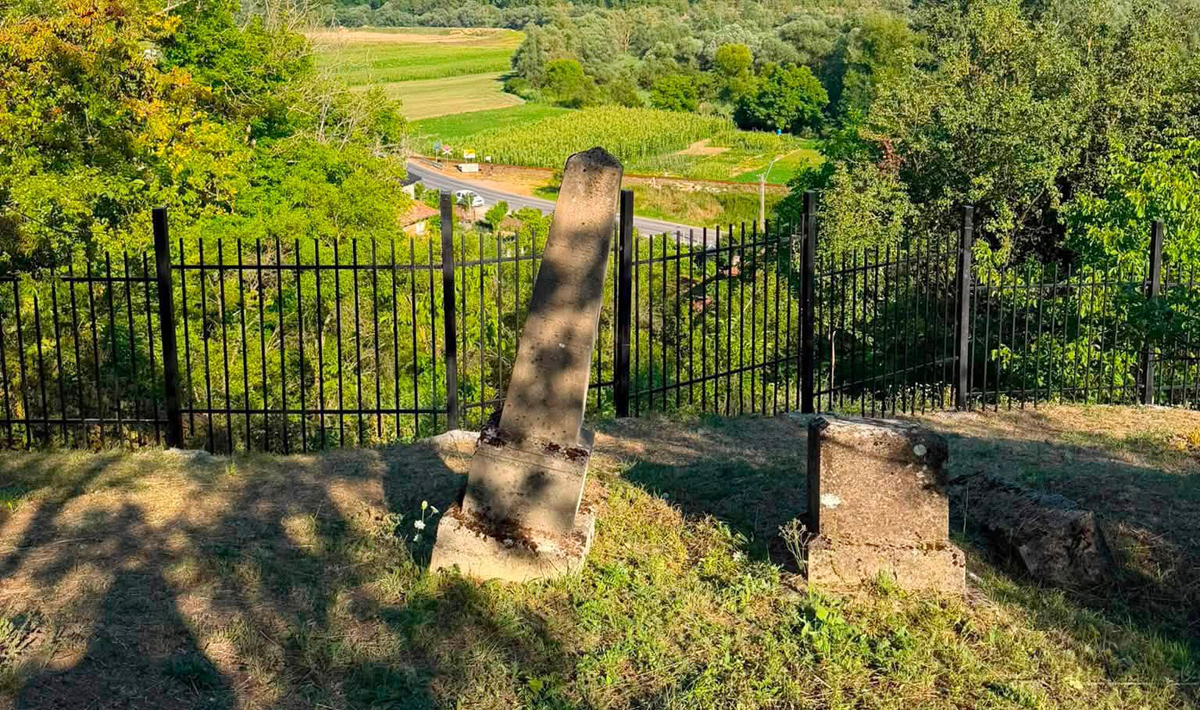
Located just steps away from residential homes, the cemetery was remarkably vulnerable. In the photos, one can even see fruit trees growing among the remaining gravestones, their trunks painted with white lime by local residents.
Without a protective fence, it is easy to imagine how the cemetery could have gradually been encroached upon or lost to surrounding agricultural and residential use.
Today, fewer than ten gravestones, dating from the 19th and 20th centuries, remain at the site. Thanks to the newly installed metal fence, all burials are now protected.
Benesat is a small village in Sălaj сounty, in Northern Transylvania. In 1869, it was home to 41 Jews. The names of several of the last Jewish families have been preserved: Mozes Samuel; Szimkha Nemes, David Lampel. Other Jewish families in the village included the Kleins, Frantzes, and Katzes.
In 1944, following the German occupation of Hungary, the Jews of Benesat were deported to the Cehei ghetto and, from there, to Auschwitz between May and June 1944. The vast majority were murdered. Today, no Jewish community remains in Benesat.
The fencing of the Benesat Jewish cemetery was made possible thanks to the support of the German Federal Foreign Office (Auswärtiges Amt) and the work of Dan Has, ESJF local coordinator in Romania and President of the Jewish Community of Sălaj (Comunitatea Evreilor Zalau Sj).